Hasegawa Tōji
1970 to 1970
Japan


Biography
The Hasegawa School was founded by Hasegawa Tōhaku (1539–1610) in the late 16th century. Despite being small, consisting mostly of Tōhaku, his sons, sons-in-law and a few known pupils, it is known today as one of the most influential artistic groups of the period. Its members conserved Tōhaku's quiet and refined aesthetic, which many attribute to the influence of Sesshū Tōyō (1420–1506) as well as his friend and contemporary, the tea master, Sen no Rikyū (1522–1591). Initially influenced by the predominantly monochrome ink paintings of Sesshū, the Hasegawa School also produced opulent and dynamic paintings decorated with rich colours and gold leaf, which became popular with the new ruling military class and decorated the interiors of their castles and temples.
Tōhaku's most noted contemporary, Kanō Eitoku (1543–1590), often competed with him for the patronage of one of the main unifiers of Japan, the daimyō Toyotomi Hideyoshi (1536–1598). Following Eitoku's death in 1590, Tōhaku stood alone as the greatest living master of his time. Chosen by Hideyoshi, the Hasegawa School gained power and popularity, enabling the production of some of the finest and most admired paintings of the period.
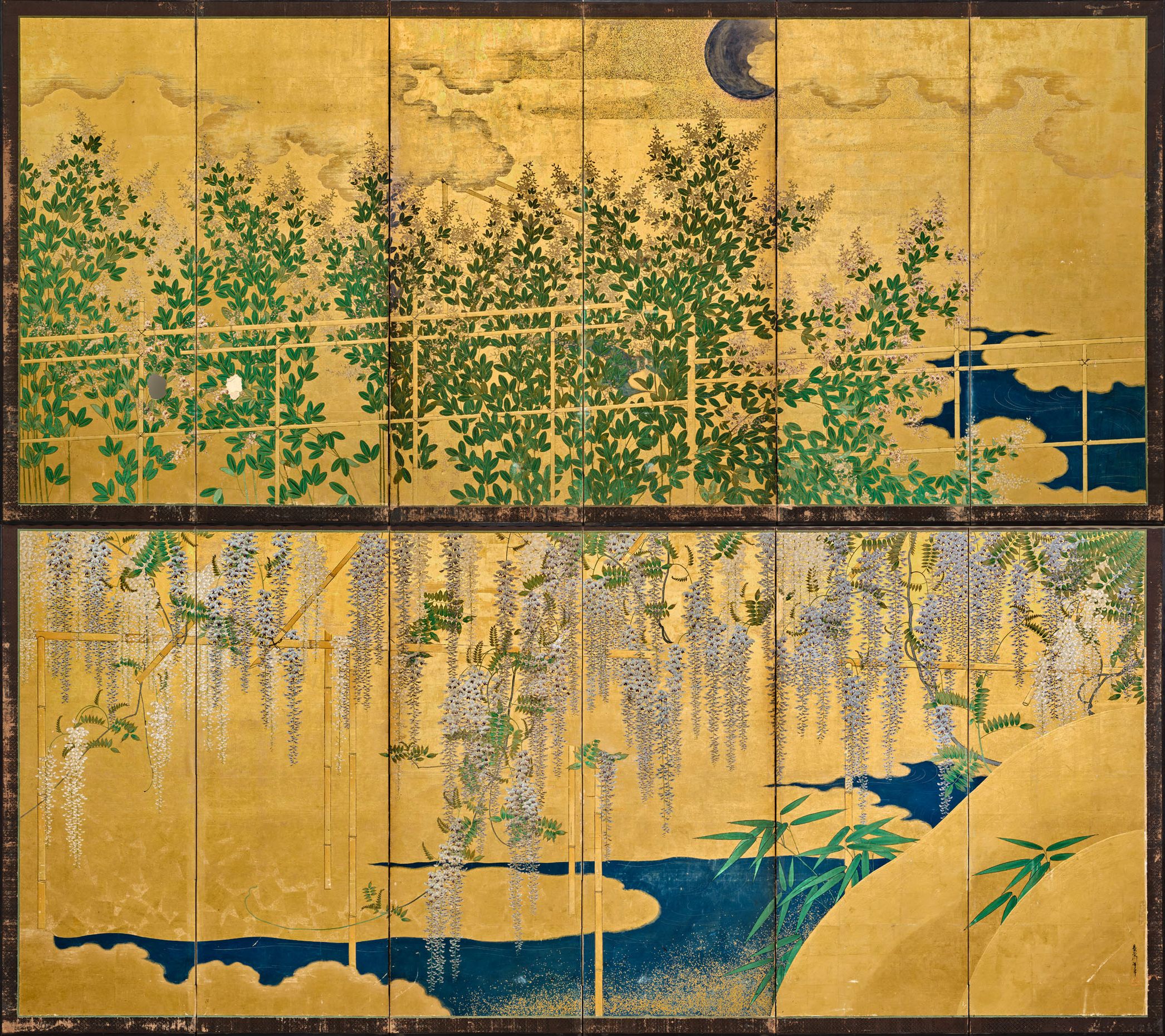
Despite the fame of the school, very little is known about the artist Hasegawa Tōji (active in the first half of the 17th century), who appears to have been a highly accomplished member of the Hasegawa School. The only other known work by Tōji is a pair of screens Bamboo and Wisteria, previously in the private collection of the politician and lawyer Mr Kiyoomi Taman (1892–1979), now housed in the Osaka City Museum of Fine Arts. This pair depicts bamboo in ink wash on a gold ground; amongst the bamboo are wisteria flowers in colour with wildflowers such as dandelions, violets and epiphytic ferns on the ground. The subdued tone and effective use of blank space in the Osaka screens may present a somewhat different aesthetic to our current pair (7859), which celebrate an abundance of flowers in vibrant hues. However, the delicate and graceful rendering of the wisteria flowers in both pairs clearly indicates they were created by the same hand. Additionally, as with the present pair, the right-hand screen of the Osaka pair is signed Hasegawa Tōji hitsu (brushed by Hasegawa Tōji) and sealed Tōji, while the left screen bears the Tōji seal.
Since no other works by Tōji nor written records about him are known, this has remained an area of limited scholarly discussion so far. In the 1949 edition of the Kokka journal, the eminent art historian Yamane Yūzō affirmed that the artist Hasegawa Tōji belonged to the Hasegawa School and dated the Osaka pair to the first half of the 17th century. In the catalogue entry for the 2017-2018 exhibition of Japanese screens at Uffizi Galleries in Florence, the curator, having analysed the painting style, writes that Tōji was one of Tōhaku's pupils despite the lack of written records. A recent conservation project at the Osaka City Museum of Fine Arts uncovered old account books within the frames of the Bamboo and Wisteria screens, further confirming their production during the early-modern period.