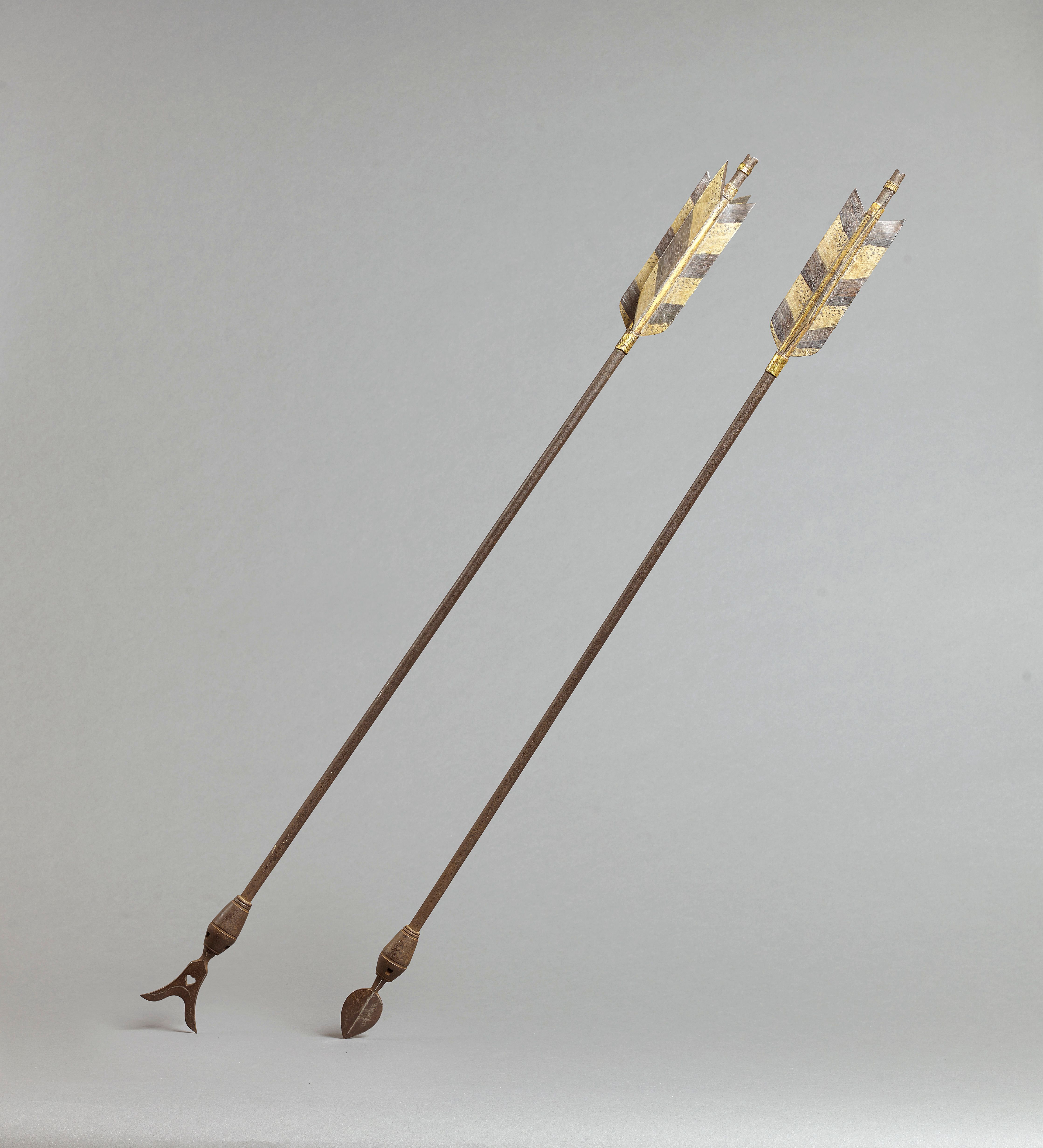
Two iron kahira (whistling) arrows with gilded and black painted flights.
Japan 19th century Edo period
Dimensions: L: 95cm (37½”)
One arrow has a karimata ("rope cutter"/mackerel tail/swallow tail) head. These arrowheads are sometimes referred to as 'rope cutters' but were most likely not used to cut ropes. They were used for hunting large game such as deer and bear and on the battle field to deliver fatal wounds to horses.
The other is a yanagi-ba (willow leaf) with saw-cut patterns like sakura (cherry blossom) or inome (heart shape or boars eye). These arrowheads are usually signed on the blade below the piercing and above the shoulder. Normally there are characters on both sides of the blade but in many cases the mei (signature) has been almost polished away.
The whistling part of the arrow kabura literally translates as "turnip", so the Japanese term technically means "turnip-shaped arrows."
The arrows would also be sold at Shintō shrines as good luck charms, particularly around New Year's Day; simply carrying a kabura-ya is meant to serve as a ward against evil spirits.
Works of Art


A kakebotoke


A wood Kyōgen mask of Usobuki

A Chinese Suiseki (viewing stone)

A bronze flower vessel of mimikuchi

A pottery kake hanaire (hanging flower vessel)

A red lacquer Kamakura-bori dai-kogo (incense box)

A Lacquered Shield

A bronze brazier

A bronze hanging flower vessel


A Chinese bronze censer

A ceramic vase by Makuzu Kōzan II


A ceramic te-aburi (hand warmer)


A suiseki (viewing stone) of vertical form with a natural striation resembling a waterfall, with wood stand

A Tokoname storage jar

A bronze flower vessel

A wood Noh mask of Koomote

A black lacquer bon (tray)

A bronze brazier

An iron nyoi

A Tokoname storage jar