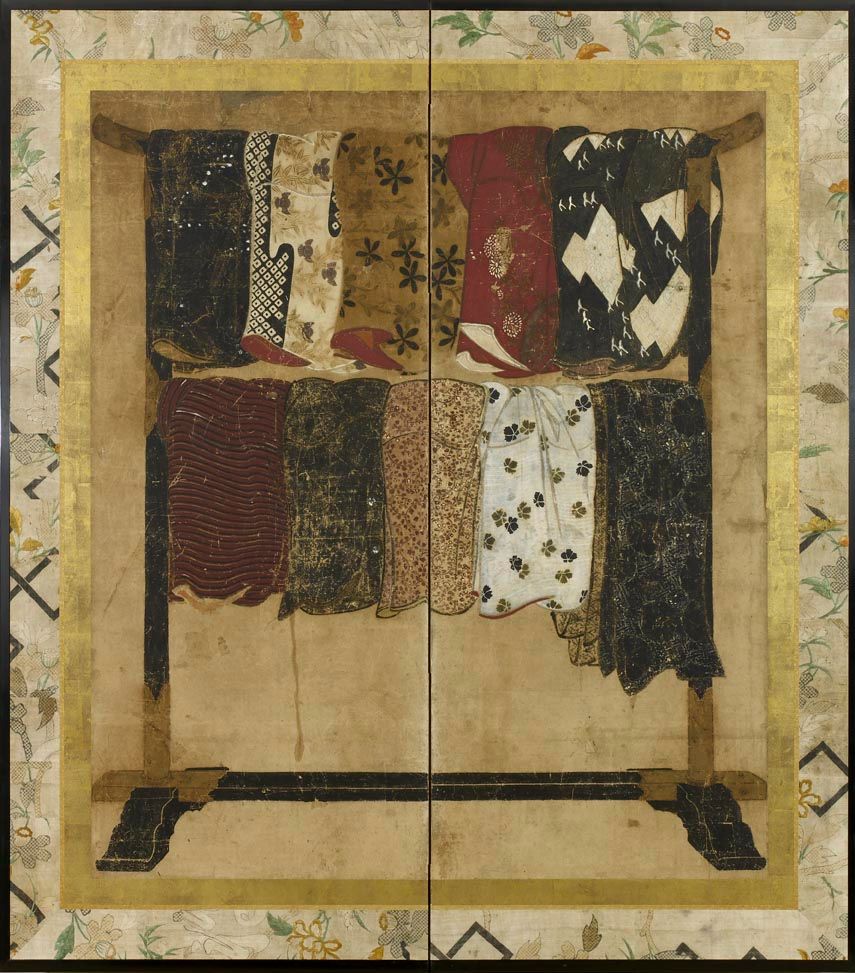
A two-fold paper screen painted in ink and colour on a gold ground with numerous kimono placed on a rack.
Japan, Edo period, 17th century
This style of screen is known as Tagasode meaning “Whose sleeves?” The word was used often in Japanese poetry, particularly in the Fujiwara and Kamakura periods, as a “pillow-word,” or leading into a poem. Tagasode traditionally conjures up the image of a beautiful woman whose presence is missed; elegant kimono sleeves, and the fragrance arising from the garment, were believed to evoke melancholy thoughts of the absent loved one. The Tagasode theme also became a favourite among some late-fifteenth-century lacquer-makers, who depicted plum flowers and incense burners that suggest fragrant scents, and who cleverly incorporated the letters reading Tagasode into their pictorial designs.
While these paintings may be interpretations of a Heian literary theme, it was also ancient practice to drape beautiful kimonos over clothes racks and employ them as temporary, movable partitions, much as folding screens were used. At picnics colourful kimono were draped over ropes to create temporary enclosures. Apart from its utilitarian function, the practice of hanging or draping kimonos offered the opportunity for an ostentatious display of valued possessions, in the manner of a fashion show. Tagasode screens of clothes-laden racks thus bear a multifaceted symbolism; the kimono racks in the image represent temporary partitions, and the actual screens serve this purpose in real life.
Screens


An eight-fold screen depicting flowers of the four seasons


A two-fold lacquer screen carved with an abstract geometric design


A six-fold paper screen with poem slips


A pair of six-fold screens depicting ‘One Hundred Boys'


A pair of six-fold screens depicting the maritime routes of the Seto Inland Sea and of the north of Kyushu Island


Tanomura Chokunyu - screen painted in ink on a silver ground with a rock, bamboo and calligraphy


A two-fold lacquer screen with an abstract landscape


A four-fold screen with calligraphy “Hishō" (Fly High)


A pair of six-fold paper with sweetfish


A pair of six-fold screens with clematis


A six-fold screen with a covey of uzura and chicks


A six-fold screen with grape vines


A two-fold screen with chrysanthemums


A pair of six-fold paper screens with the Plains at Musashino


A pair of four-fold screens with kuri flowers


A pair of six-fold screens with scattered fans


Four fusuma by Nagasawa Rosetsu


A six-fold screen with autumn flowers and grasses


A paper screen with the Uji river and its bridge


A two-fold screen with a river landscape


A two-fold screen with court ladies


A pair of six-fold screens with poem slips from the 17th century


A two-fold screen with the Uji River and its bridge


A six-fold paper screen with the Plains at Musashino

A screen with abstract calligraphy “Garden”


Triptych screen by Suda Kokuta


A two-fold lacquer screen with a persimmon tree


A two-fold batik silk folding screen


A lacquer screen by Onaga Tamotsu