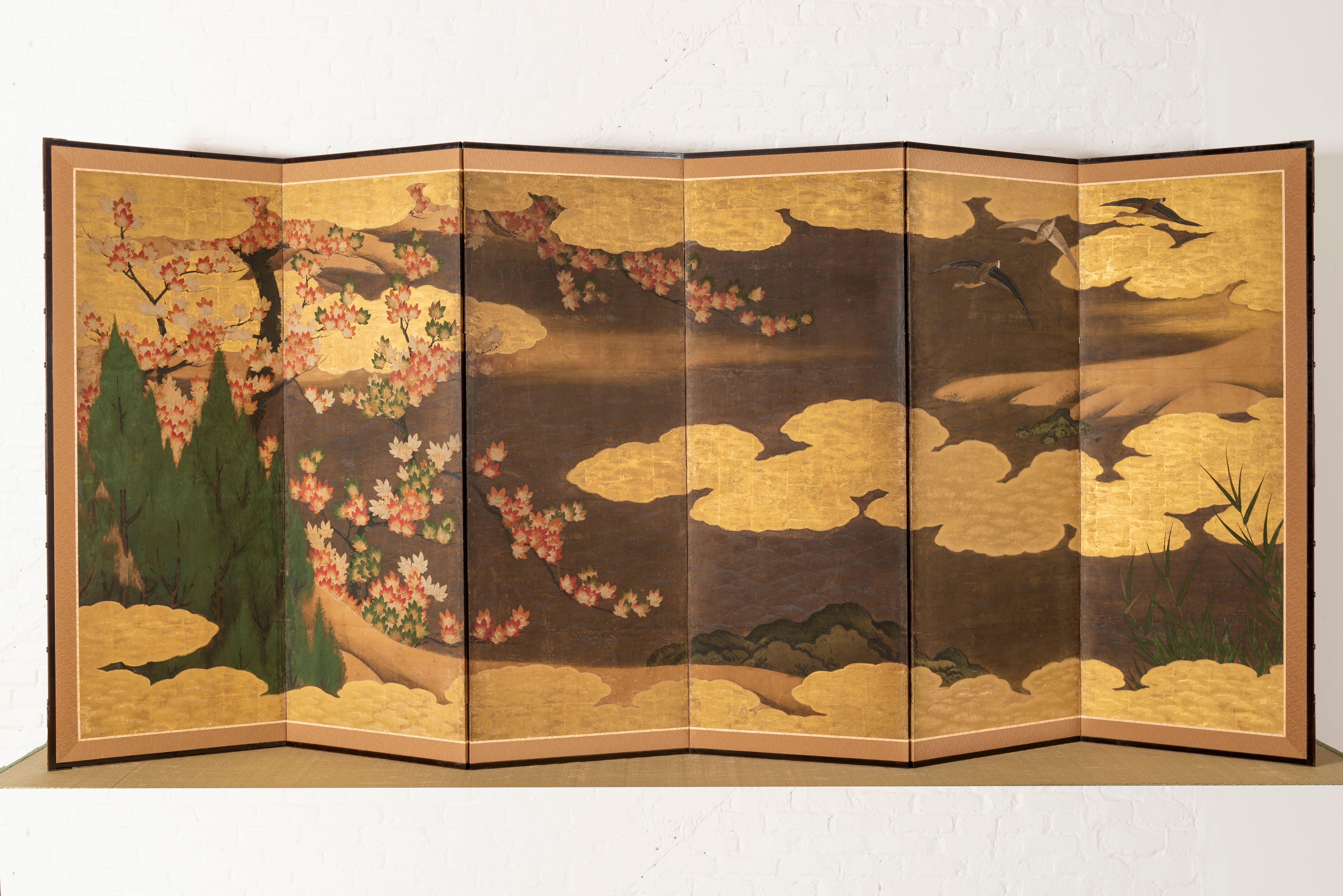
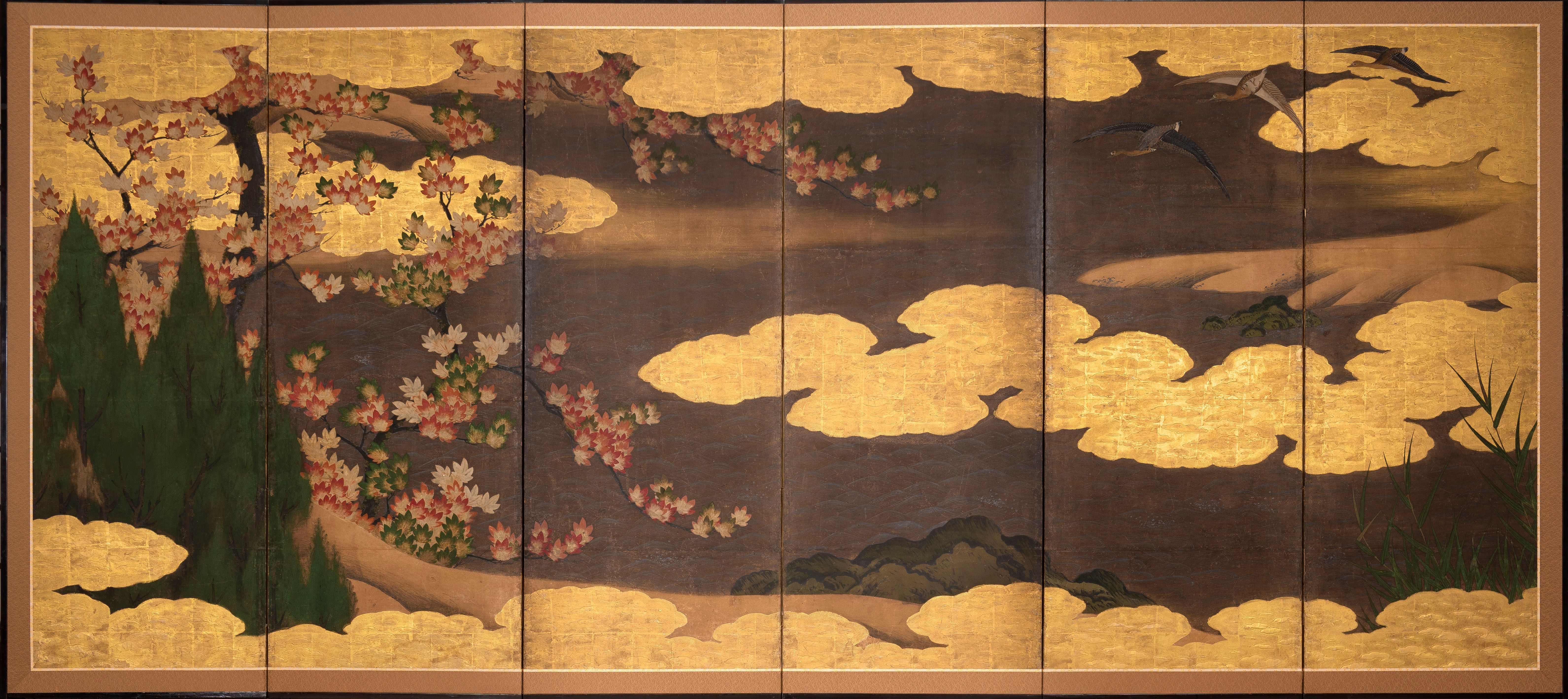
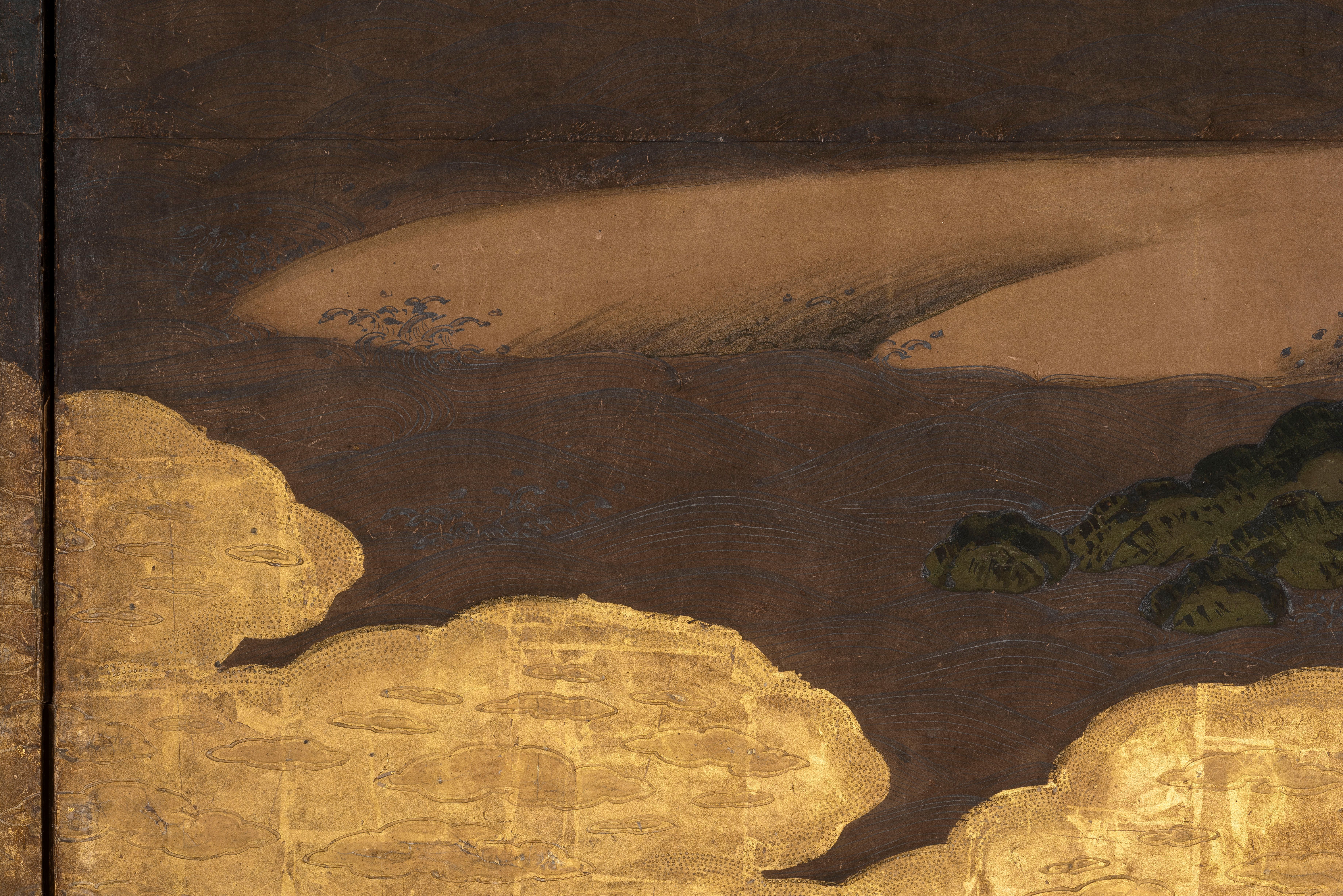
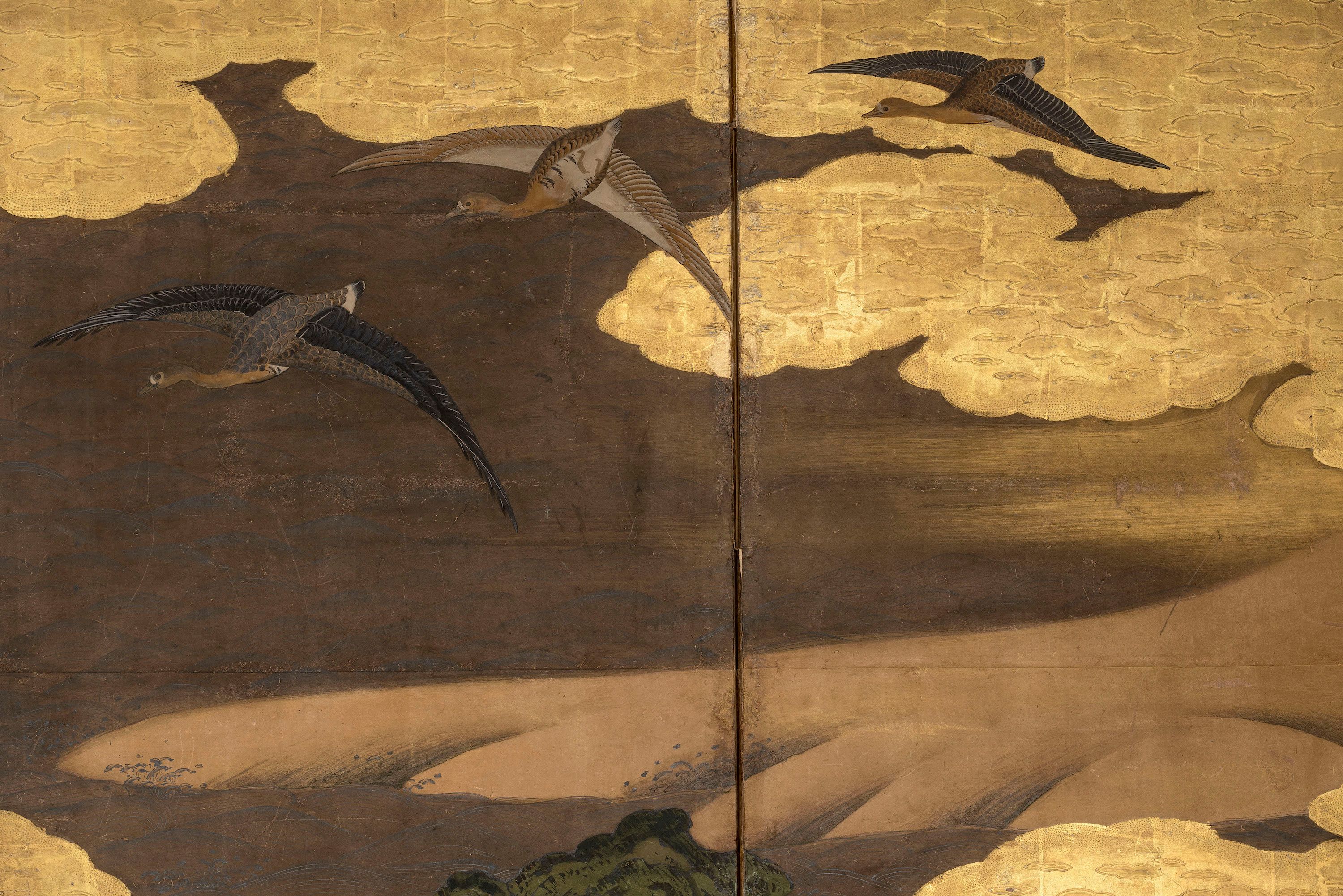
SOLD _ A six-fold paper screen depicting conifer and maple trees in autumn beside the Tatsuta River with three geese in flight amongst gold clouds
#7738
H. 171.5cm x W. 382cm (67½" x 150½")
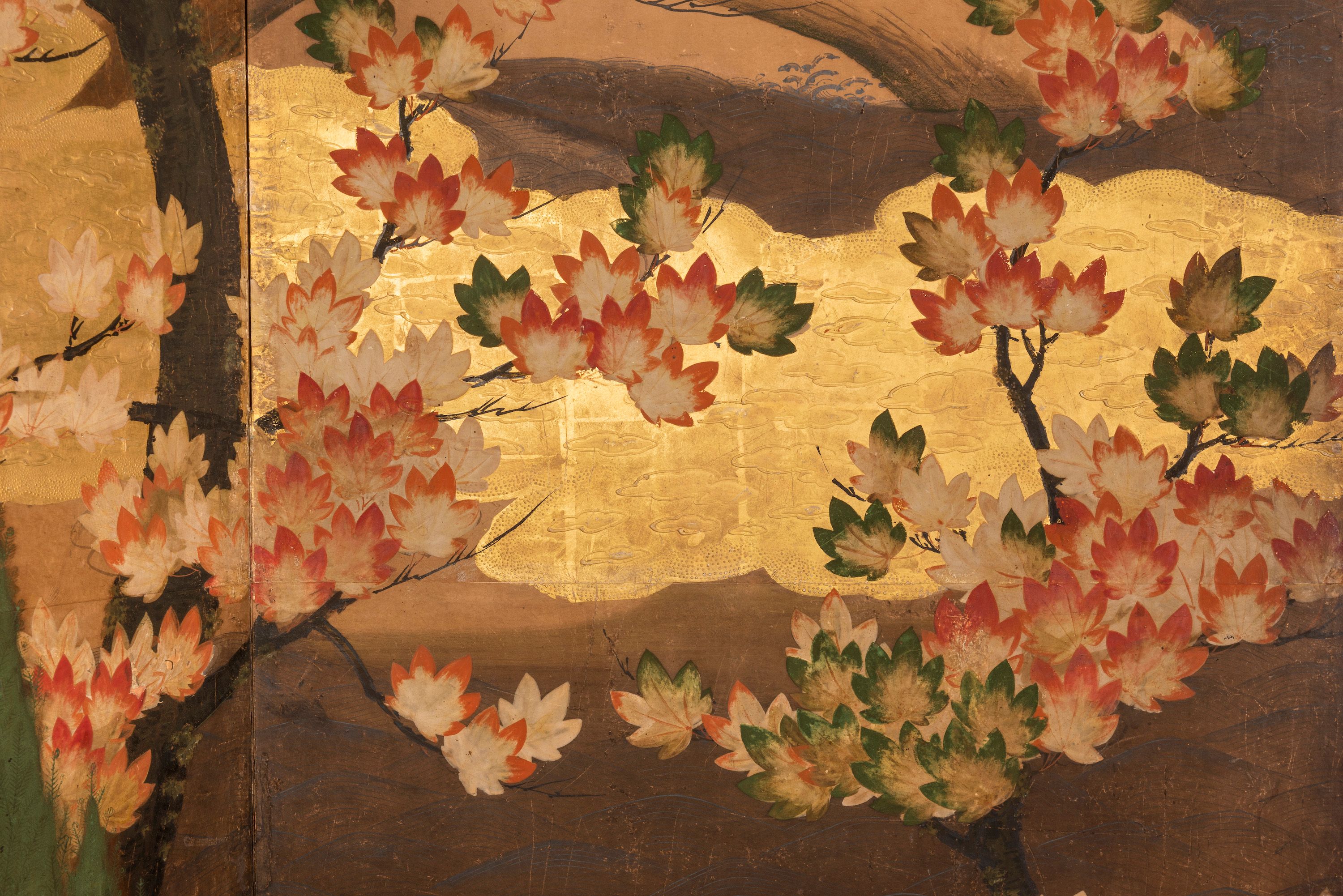
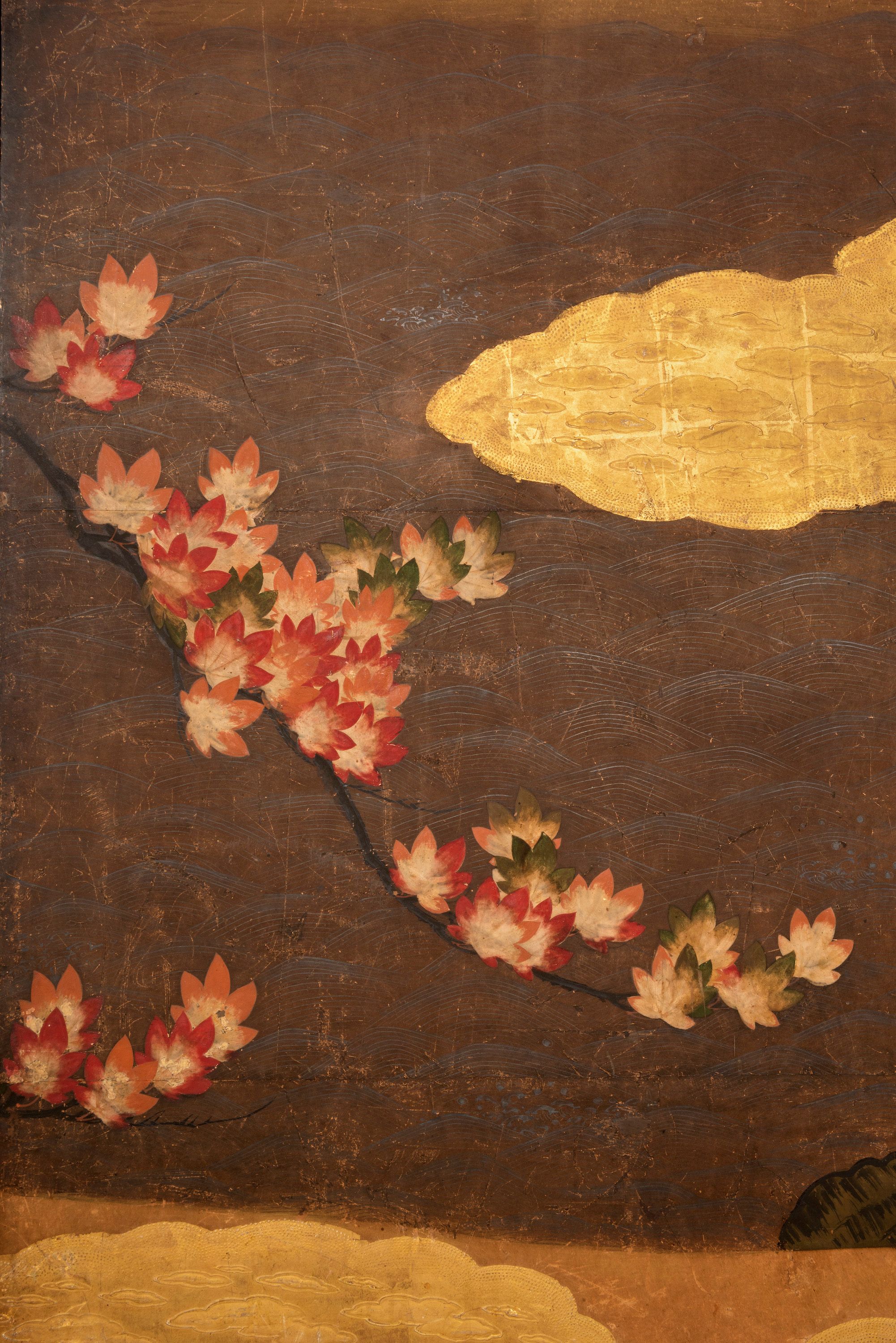
A six-fold paper screen painted in ink, colour, gofun (powdered shell), silver and gold leaf, depicting conifer and maple trees in autumn beside the Tatsuta River with three geese in flight amongst gold clouds rendered in moriage (raised design)
Hasegawa School, Japan early 17th century Edo period
Provenance:
Convexity Capital Management LP, Boston, MA, USA
Maple (momiji) shares pride of place with cherry blossom (sakura) as one of the two most important seasonal symbols in Japan. The changing colours of its leaves have long captivated the people of Japan and this much admired autumnal motif has been mentioned in poems and literature such as Manyōshū (Collection of Ten Thousand Leaves), Nara period (645-781); The Tale of Genji from the Heian period (782-1184); and the popular Noh play Momiji-gari (Maple Viewing) of the Muromachi period (1392-1572). It is one of the most popular subjects in Japanese paintings and works of art.
The imagery of this autumn river scene can be associated with one of the most famous poems by Ariwara no Narihira (825-880), a courtier and poet of the early Heian period.
Chihayaburukami-yo mo kikazu
tatsuta-gawakara-kurenai ni
mizu kuguru to wa
Such beauty,
unheard of
even in the age of the mighty gods;
maples tie-dye the waters of the Tatsuta
a brocade of deep crimson
Ariwara no Narihira has been regarded as an archetype of handsome, amorous nobleman of the Heian period and appears in many literary works including Ise Monogatari (Tales of Ise, 9th-10th century) where Narihira is considered to be a model of the hero. The Tatsuta River in Nara is known to have been a popular site with early aristocrats for its beautiful scenery due to the changing colours of the maple. This poem was included in the Hyakunin Isshu (one hundred people, one poem), a classical anthology of waka poetry compiled by Fujiwara no Teika (1162-1241), and there are several stories about this poem — Kokin-wakashu (Collection of Poems from Ancient and Modern Times, c. 905) suggests that it was composed when Narihira saw a screen painting depicting maples and the Tatsuta River, while the Tales of Ise mention it was written on site.
The Hasegawa School was founded by Hasegawa Tōhaku (1539-1610) in the late 16th century to early 17th century. Despite being small, consisting mostly of Tōhaku, his sons and sons-in-law, it is known today as one of the most influential artistic groups of the period. Its members conserved Tōhaku's quiet and reserved aesthetic, which many attribute to the influence of Sesshū Tōyō (1420-1506) as well as his contemporary and friend, Sen no Rikyū (1522-1591).
A similar depiction of silver waves can be found on a screen depicting Ukifune (A Boat upon the Waters), Hasegawa School (Momoyama period, late 16th - early 17th century) in the collection of Okada Museum of Art, Kanagawa prefecture. See Okada Museum of Art ed., Masterpieces of the Okada Museum of Art, (Korea, 2013), p. 120-121, no. 88.
A similar depiction of conifer can be found on a set of fusuma (sliding doors) with cherry and cedar from the Hasegawa School in the collection of Myōren-ji temple, Kyoto (an Important Cultural Property).
Screens


An eight-fold screen depicting flowers of the four seasons


A pair of six-fold screens depicting ‘One Hundred Boys'


A six-fold paper screen with poem slips


A pair of six-fold screens depicting the maritime routes of the Seto Inland Sea and of the north of Kyushu Island


Tanomura Chokunyu - screen painted in ink on a silver ground with a rock, bamboo and calligraphy


A pair of six-fold paper with sweetfish


A pair of six-fold screens with clematis


A six-fold screen with a covey of uzura and chicks


A six-fold screen with grape vines


A two-fold screen with chrysanthemums


A pair of six-fold paper screens with the Plains at Musashino


A pair of four-fold screens with kuri flowers


Four fusuma by Nagasawa Rosetsu


A six-fold screen with autumn flowers and grasses


A paper screen with the Uji river and its bridge


A pair of six-fold screens with scattered fans


A two-fold screen with a river landscape


A two-fold screen with court ladies


A pair of six-fold screens with poem slips from the 17th century


A two-fold screen with the Uji River and its bridge


A six-fold paper screen with the Plains at Musashino